Showing posts with label HERBAL FLOWERS. Show all posts

Tuesday, November 03, 2009

Herbal Flowers #7

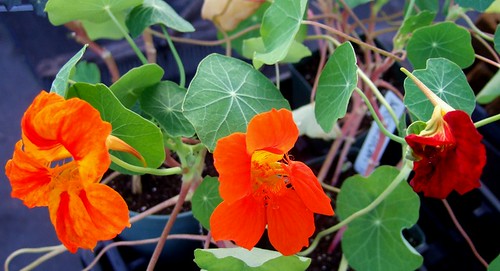
Herb Flowers Nasturtium

Pictured above are nasturtiums, Tropaeolum majus, one of my favorite herbs. The flowers are not only beautiful in the garden, but are one of the best edible flowers around.

A member of the Cruciferae (mustard) family, nasturtium has leaves and flowers with a great cress-like peppery taste from benzyl isothiocyanate, a form of mustard oil. High in vitamin C, the leaves as well as the flowers make a great addition to a salad of mixed greens. I have also made a delicious pesto using half nasturtium leaves and half parsley instead of the usual basil.

Now is the time of year to start growing nasturtiums here in Florida as they deteriorate in the intense heat of our summers. They also dislike extreme cold, so take care to protect them or bring them in when the temperature dips into the 30s. They're easy to grow, preferring full sun and very little fertilizer in order to flower. (Too much fertilizer will give you lots of leaves with little flowering.) Nasturtiums come in mounding and vining forms, several flower colors and a variety with variegated leaves.

Saturday, August 25, 2007

Herbal Flowers #6


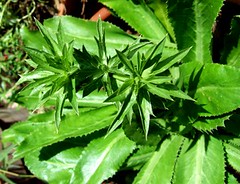
Earlier in this Herb Flowers series, I showed pictures of cilantro flowers. The spiky green flowers above are from a cilantro-flavored herb called culantro (Eryngium foetidum). Culantro is native to Mexico and Central and South America where it is widely used. It is great for Florida where cilantro is quick to bolt and is extremely difficult to grow in the summer garden. While cilantro is a cool weather annual, culantro is a warm weather perennial. It will grow here all year round, but needs to be protected if the temperature dips into the 30's. Grow in partial shade; it will take the heat of our summers but not in full sun.

Culantro is a low growing plant with flower spikes that have a conical flower head surrounded by spiky leaves that can be quite prickly to the touch. The lower basal leaves have a saw-toothed edge, but are soft and edible. They are the part used in culinary applications and can be used wherever cilantro is called for. Remove the flower spikes to encourage more basal leaf growth.

Sunday, July 08, 2007

Herbal Flowers #5


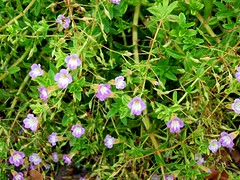
These cute little purple and white flowers belong to rice paddy herb (Limnophila aromatica) one of my favorite smelling herbs. Easily recognized by those familiar with Vietnamese cooking, it is unfamiliar to most of my customers. The scent is quite powerful, nearly identical to cumin, and I'm hoping to find a good recipe utilizing it. Anyone?

As the name indicates, it is native to southern Asia and grows in very wet areas. It is rated for zone 10. I was struck with the similarity between this herb and the water hyssops in our butterfly garden: similar flowers, long succulent stems, similar succulent leaves and watery habitat. Sure enough, they are in the same plant family, Plantaginaceae.

Friday, July 06, 2007

Herbal Flowers #4


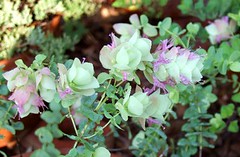
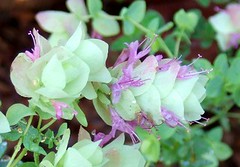
This is Oreganum 'Kent Beauty', an ornamental oregano with beautiful flowers unlike any other oreganos. Rated for zones 5-8 (we're in 9B here in central Florida) and liking a dry, very well-drained soil, it's obviously not going to be the easiest plant to grow here, but well worth the trouble.

Tuesday, July 03, 2007

Herbal Flowers #3


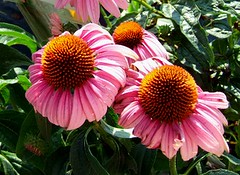
Echinacea spp. or purple coneflower produces beautiful flowers for any garden including the herb garden and butterfly garden. Native to the Midwest prairies, its medicinal roots were first used by native American Indians and it is considered today a major herbal immuno-stimulant. Butterflies love it as a nectar plant.


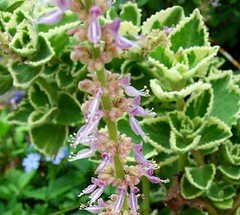
Besides the many species of true oreganos (Oreganums) there are a number of other oregano tasting plants which use the common name oregano and are often substituted for the true oreganos in culinary applications. One such herb is Cuban oregano, Plectranthus amboinicus. Originally classified as a coleus and named Coleus amboinicus, it comes in a plain green form as well as several differently variegated forms, one of which is pictured above. Plants in the Coleus and Plectranthus genera are part of the Lamiaceae (mint) family and the flowers are typical of that family. The real and year-round beauty of this plant, though, comes from its variegated leaves.


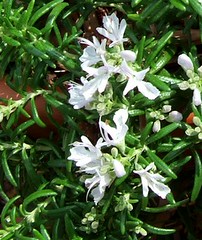
Many customers at my herb farm express surprise when they see mature rosemary plants covered in flowers. Yes, rosemary does flower and the flowers come in many colors: pink, white, light lavender, light blue and deep blue. These flower colors are reflected in many of the varietal names: Majorca Pink, Alba, Tuscan Blue, etc.

Pictured is a new variety of rosemary called Haifa which I loved right away. It's a very low-growing prostrate variety with dark glossy leaves and a kind of twisty growth habit. I loved this variety even more when it flowered. It had the largest flowers I have seen on any of my rosemarys and the stems were just solid with them. Fantastic.

Monday, July 02, 2007

Herbal Flowers #2


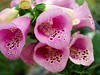
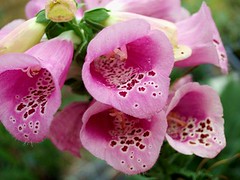
I think the most beautiful of all the herb flowers is foxgloves. It's an herb? you may ask. Absolutely. Digitalis purpurea is the source of the potent heart medication digitalis. But potent heart medications are dangerous and all parts of the foxglove plant should be considered poisonous. I always make sure my customers know this before they leave with these plants in hand.

Foxgloves are biennials, nearly all of them following the biennial pattern of not flowering until the second year. For those of us in Florida, this means foxgloves are rarely attempted as it is very difficult to get them though the first summer's heat and humidity. The pictured foxglove is a variety called "Foxy" and will flower the first year, allowing us to grow it as an annual.

Foxgloves are the quintessential fairy garden plant and were used for one of Cicely Mary Barker's flower fairies. The spots are like little stepping stones which say to bees "Come this way, the good stuff is in here".
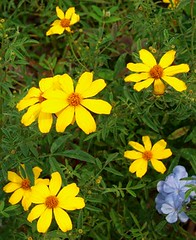


This intensely fragrant plant is Tagetes lemmonii with the common names lemon marigold, copper canyon daisy and mountain or lemmon's marigold. Of all the plants I've ever had in my garden, this one releases the most noticeable fragrance when barely touched or watered. Kind of a funky smell, some say a lemon scent; but the species name lemmonii comes from the botanical explorer J G Lemmon who discovered it in its native Arizona.
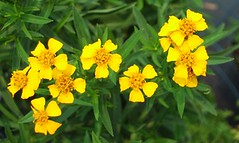


These flowers look similar to the ones above which is no surprise since this plant is the close relative Tagetes lucida. Commonly called Mexican mint marigold, it is used like tarragon in this area and so is also found sold under the common names Mexican, Texas, Spanish, tropical or winter tarragon.

True French tarragon (Artemisia dracunculus) is impossible to grow in Florida. It hates our hot humid summers and requires several months of dormancy brought on by winter freezing. If you live here in Florida and buy fresh tarragon in those little packages at the grocery store, you may have been using this tarragon all along. The fresh tarragon sold in our local grocery stores is nearly always this type since most of our local herbal produce is grown in south Florida.

Mexican tarragon is not as peppery as French tarragon and has more of an anise flavor, but it makes a great substitute. I add it to my homemade tartar sauce.
Sunday, July 01, 2007

Herbal Flowers #1


Lots of herb flowers in the garden now. The mints seem to be the most popular with the bees.


The fennel plants are full of flowers. Leaves (and flowers, too) have a licorace flavor, but it's the seeds that pack the big taste. If you buy fennel seeds in the store, you'll get the brown dried ones, but the less mature green ones are better tasting. If you want seeds for making more fennel plants though, you'll need to let them get to the brown dry stage.


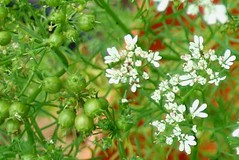
Another herb with tasty seeds is cilantro. Fennel and cilantro are in the same plant family, Apiaceae, which has several other members with flavorful seeds: celery, dill, caraway, anise and cumin. The pretty little white flowers of cilantro are edible and have a sweet and very mild cilantro taste. The seeds of the cilantro plant, by the way, are given their own name (coriander).