Showing posts with label milkweed. Show all posts

Saturday, January 26, 2008

In the Butterfly Garden: Another Milkweed


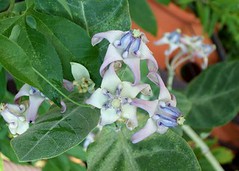
Several years ago I started seeing growers selling giant milkweed (Calotropis gigantea) at butterfly gardening festivals. These were large plants in 3 gallon pots that sold in the neighborhood of $25. Though I had not seen any with monarch caterpillars, I was assured the giant milkweek was a good host plant. After seeing them several times, I finally broke down, purchased one and started taking cuttings. My hope was to be able to offer smaller plants at a lower price. They are not the easiest thing to propagate, but I have several going and sell them in a 1 gallon pot for $9.99.

Giant milkweed gets to be a large plant several feet high and would be great in ground here in central Florida except that our winter weather is a bit too cold. Calotropis is recommended for US zones 10B-11. We are 9B. My recommendation is to grow it in a large container and bring indoors when the temperature dips into the 30s.

The leaves of giant milkweed are large and a silvery green. The flowers come in lavender or white, though I only have the lavender. I've had plenty of flowers, but have yet to get any seed pods.

So the big question for butterfly gardeners is are they good host plants? Answer:
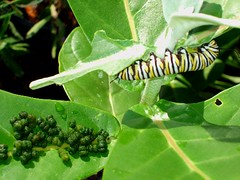


I've had lots of healthy monarch caterpillars on my giant milkweeds. And, as you can see, the large leaves give them more to eat than regular milkweed and also make a nice platform for collecting caterpillar poop.

Wednesday, July 04, 2007

In the Butterfly Garden: Everyone Loves Milkweed!

The one plant that is the first to be planted in just about every butterfly garden is milkweed (Asclepias spp.). A host plant for the monarch and queen, it's also a decent nectar plant for a wide variety of butterflies. But move over, monarch caterpillar (below), there are other insects taking up residence in the milkweeds.


Aphids are a nearly constant presence on the tender ends. Normally the best control for aphids would be a spray like insecticidal soap, but in the butterfly garden I advise removing them with the garden hose. Luckily the aphids come off easily while the monarch eggs are sticky and not so easily dislodged. Unfortunately the aphids usually come back, so this can wind up being a daily process. Ladybugs will eat aphids so if you can attract them and keep them around, this can help too.


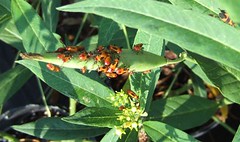
The other insects that enjoy milkweed are milkweed seed bugs. These orange and black bugs feed on the milkweed seeds. In the picture below, there is an adult in the upper right corner and lots of young nymphs on the milkweed seed pod. Usually there are only a few to be found and they can be picked off by hand. Occasionally, however, the population gets out of hand. You can try keeping the seed pods removed; otherwise spraying with insecticidal soap may be your only recourse.