Answer:
Thursday, March 19, 2009


Thursday, December 25, 2008
Friday, October 31, 2008
Five Things I Learned About Dogs Last Saturday Night

Maggie with a butterfly on her head
Five things I learned about dogs last Saturday night:
1. It’s surprisingly easy to forget that grapes are toxic to dogs until 2 seconds after yours has eaten the last bite of the leftover chicken salad Veronique you shouldn’t have given her.
2. According to various sites on the internet and the doctor answering the phone at the emergency veterinary clinic, hydrogen peroxide is the accepted method of inducing vomiting in dogs.
3. It’s easy to get the first teaspoon of hydrogen peroxide down a dog’s throat. The next few teaspoons, not so much.
4. About 20 minutes after swallowing a ¼ cup of hydrogen peroxide, a dog will expel all its previously eaten dinner along with an amazingly sticky mass of foaming goo.
5. Dogs are very quick to forgive.
Tuesday, August 12, 2008
In the Butterfy Garden: Caterpillar Predators
Customers often tell me that caterpillars they've been watching have suddenly disappeared and they wonder what could have happened to them. Sometimes they've just grown up and have gone off to pupate. But often they have become a victim of predators. Birds, of course, love a nice tasty caterpillar, but many smaller critters are predators as well. I recently captured two such predators with my camera.
This is a paper wasp devouring a monarch caterpillar. . . .

And this is what's left of a monarch caterpillar after a wasp is through with it:

Lizards (or anoles as most of our lizards are appropriately called) eat butterfly eggs and caterpillars. Here is a lizard with an adult butterfly. It was at the end of it's life and was struggling on the sidewalk. I could see the lizard eyeing it and then grab it. It was a pretty heavy load for the lizard so I had time to run get my camera and snap this picture just before the poor butterfly was carried into the brush:

This is a paper wasp devouring a monarch caterpillar. . . .
And this is what's left of a monarch caterpillar after a wasp is through with it:
Lizards (or anoles as most of our lizards are appropriately called) eat butterfly eggs and caterpillars. Here is a lizard with an adult butterfly. It was at the end of it's life and was struggling on the sidewalk. I could see the lizard eyeing it and then grab it. It was a pretty heavy load for the lizard so I had time to run get my camera and snap this picture just before the poor butterfly was carried into the brush:
Friday, July 04, 2008

Friday, June 13, 2008

Saturday, February 16, 2008
The Old Florida Flame Vines

The flame vines seem to be particularly beautiful this year including the one that has enveloped the tree above. They always remind me of the old Florida my family moved to in 1955. They were a lot more prevalent then including on the old linen postcards of that era:

Thursday, February 07, 2008
Early February Butterfly Count
Red admiral on bright pink pentas
Throughout the winter I have been seeing lots of monarchs and zebra longwings, the occasional sulphur and not much else. But suddenly yesterday I saw so many butterflies appearing for the first time this year. A quick species count from the past 3 days:

blue cassius
red admiral
yellow sulphur
monarch
zebra longwing
gulf fritillary
gold rim swallowtail
Sunday, February 03, 2008
"I think using fresh herbs makes you more adventuresome in the kitchen."
Rabbit Hill Gardens and I are mentioned and quoted by Tom MacCubbin in two articles on herbs in today's Orlando Sentinel. Thanks Tom. One mistake in one article, however: it is culantro not cilantro that does well in the summer. Cilantro is a cool-weather annual like dill that bolts quickly and wilts in the heat. Culantro is a warm weather perennial that thrives in the heat and has a very similar taste.
Saturday, January 26, 2008
In the Butterfly Garden: Another Milkweed
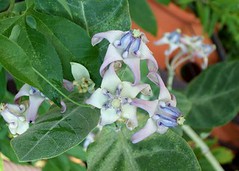
Several years ago I started seeing growers selling giant milkweed (Calotropis gigantea) at butterfly gardening festivals. These were large plants in 3 gallon pots that sold in the neighborhood of $25. Though I had not seen any with monarch caterpillars, I was assured the giant milkweek was a good host plant. After seeing them several times, I finally broke down, purchased one and started taking cuttings. My hope was to be able to offer smaller plants at a lower price. They are not the easiest thing to propagate, but I have several going and sell them in a 1 gallon pot for $9.99.
Giant milkweed gets to be a large plant several feet high and would be great in ground here in central Florida except that our winter weather is a bit too cold. Calotropis is recommended for US zones 10B-11. We are 9B. My recommendation is to grow it in a large container and bring indoors when the temperature dips into the 30s.
The leaves of giant milkweed are large and a silvery green. The flowers come in lavender or white, though I only have the lavender. I've had plenty of flowers, but have yet to get any seed pods.
So the big question for butterfly gardeners is are they good host plants? Answer:
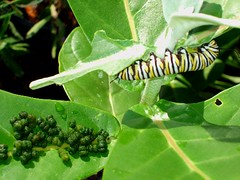
I've had lots of healthy monarch caterpillars on my giant milkweeds. And, as you can see, the large leaves give them more to eat than regular milkweed and also make a nice platform for collecting caterpillar poop.
Tuesday, November 06, 2007
In the Butterfly Garden: Two Plants with Fall Color
Among the best plants for fall color are two that are also great plants for the butterfly garden.
The first is Senna bicapsularis (syn. Cassia bicapsularis) with the common names of Christmas senna, winter cassia and fall cassia, all indicating that this is the time of year when they are at their peak of blooming. Fall cassia can be kept pruned into a tall shrub or can be let loose to form a small tree (10-12 feet). Right down the street from me on 11th Avenue in Mount Dora are a couple of fall cassias that have been planted to beautiful effect behind a white fence:


The first is Senna bicapsularis (syn. Cassia bicapsularis) with the common names of Christmas senna, winter cassia and fall cassia, all indicating that this is the time of year when they are at their peak of blooming. Fall cassia can be kept pruned into a tall shrub or can be let loose to form a small tree (10-12 feet). Right down the street from me on 11th Avenue in Mount Dora are a couple of fall cassias that have been planted to beautiful effect behind a white fence:

Fall cassia is a host plant for a number of sulphur butterfly caterpillars. These butterflies usually zoom through the yard without stopping, but will stop to lay eggs and perhaps stick around for a bit of nectar from one of your nectar plants. Pictured is a female sulphur laying an egg:

The second plant with great fall color is our native firebush (Hamelia patens) with its orange flowers and black berries. Firebush gets to be a tall shrub and can be grown in either full sun or partial shade. It is a favorite nectar plant of the two passionvine butterflies in our area: the gulf fritillary and the zebra longwing.

Thursday, September 06, 2007
Mislabeled
I was starting some nasturtium seeds today and saw on one of the packages something that reminds me how often garden things are mislabeled for Florida.
Many seed packages have a little map on the back and a chart that shows which months the seeds should be started in each area. For nasturtiums, which do best in cool weather, the package from American Seeds had it right: start seeds here Sept-Feb. This way they will be growing in the cool fall, winter and early spring and will only have to be protected on those few nights when temperatures approach freezing. But the Northrup-King seed package had it exactly backwards: start seeds here Feb-Sept. Obviously they were following the first frost dates for the northern zones and continued it for the most southern. But that would have us growing nasturtiums in late spring and summer when they will struggle in the heat.
I'm constantly running across things I think are mislabeled, especially mislabeled for Florida and I will try to post more as I run across them.
Many seed packages have a little map on the back and a chart that shows which months the seeds should be started in each area. For nasturtiums, which do best in cool weather, the package from American Seeds had it right: start seeds here Sept-Feb. This way they will be growing in the cool fall, winter and early spring and will only have to be protected on those few nights when temperatures approach freezing. But the Northrup-King seed package had it exactly backwards: start seeds here Feb-Sept. Obviously they were following the first frost dates for the northern zones and continued it for the most southern. But that would have us growing nasturtiums in late spring and summer when they will struggle in the heat.
I'm constantly running across things I think are mislabeled, especially mislabeled for Florida and I will try to post more as I run across them.
Saturday, August 25, 2007
Herbal Flowers #6
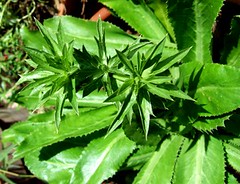
Earlier in this Herb Flowers series, I showed pictures of cilantro flowers. The spiky green flowers above are from a cilantro-flavored herb called culantro (Eryngium foetidum). Culantro is native to Mexico and Central and South America where it is widely used. It is great for Florida where cilantro is quick to bolt and is extremely difficult to grow in the summer garden. While cilantro is a cool weather annual, culantro is a warm weather perennial. It will grow here all year round, but needs to be protected if the temperature dips into the 30's. Grow in partial shade; it will take the heat of our summers but not in full sun.
Culantro is a low growing plant with flower spikes that have a conical flower head surrounded by spiky leaves that can be quite prickly to the touch. The lower basal leaves have a saw-toothed edge, but are soft and edible. They are the part used in culinary applications and can be used wherever cilantro is called for. Remove the flower spikes to encourage more basal leaf growth.
Thursday, July 12, 2007
Thank you Lady Bird Johnson
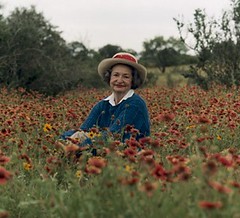
Picture in public domain available from Johnson Library.
Thank you Lady Bird Johnson for making this country a more beautiful place. In 1998, before I opened Rabbit Hill Gardens, I went to an Herb Growing & Marketing Network conference in San Antonio which offered a bus tour that included the famed Frederickberg Herb Farm and the Lady Bird Johnson Wildflower Center. The tour through her beloved Texas Hill Country was definitely the best part of a great conference. Rest in peace Lady Bird.
Sunday, July 08, 2007
Herbal Flowers #5
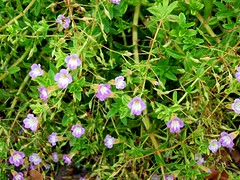
These cute little purple and white flowers belong to rice paddy herb (Limnophila aromatica) one of my favorite smelling herbs. Easily recognized by those familiar with Vietnamese cooking, it is unfamiliar to most of my customers. The scent is quite powerful, nearly identical to cumin, and I'm hoping to find a good recipe utilizing it. Anyone?
As the name indicates, it is native to southern Asia and grows in very wet areas. It is rated for zone 10. I was struck with the similarity between this herb and the water hyssops in our butterfly garden: similar flowers, long succulent stems, similar succulent leaves and watery habitat. Sure enough, they are in the same plant family, Plantaginaceae.
Saturday, July 07, 2007
Looking for photos of roadside gardens
Sissy Willis calls it "when plants garden". You know, roadside wildflowers that pop up without being planted. Fred First is looking for pictures for his online gallery Unplanted Gardens: America's Roadside Bloomery. Go there to see a beautiful example and how to submit your own photos. And look around Fred's site for more gorgeous photos from the Blue Ridge Mountains.
Friday, July 06, 2007
Herbal Flowers #4
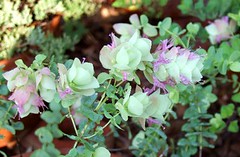
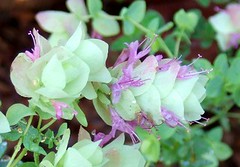
This is Oreganum 'Kent Beauty', an ornamental oregano with beautiful flowers unlike any other oreganos. Rated for zones 5-8 (we're in 9B here in central Florida) and liking a dry, very well-drained soil, it's obviously not going to be the easiest plant to grow here, but well worth the trouble.
Wednesday, July 04, 2007
In the Butterfly Garden: Everyone Loves Milkweed!
The one plant that is the first to be planted in just about every butterfly garden is milkweed (Asclepias spp.). A host plant for the monarch and queen, it's also a decent nectar plant for a wide variety of butterflies. But move over, monarch caterpillar (below), there are other insects taking up residence in the milkweeds.

Aphids are a nearly constant presence on the tender ends. Normally the best control for aphids would be a spray like insecticidal soap, but in the butterfly garden I advise removing them with the garden hose. Luckily the aphids come off easily while the monarch eggs are sticky and not so easily dislodged. Unfortunately the aphids usually come back, so this can wind up being a daily process. Ladybugs will eat aphids so if you can attract them and keep them around, this can help too.

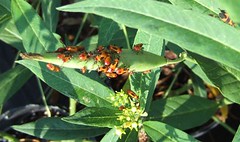
The other insects that enjoy milkweed are milkweed seed bugs. These orange and black bugs feed on the milkweed seeds. In the picture below, there is an adult in the upper right corner and lots of young nymphs on the milkweed seed pod. Usually there are only a few to be found and they can be picked off by hand. Occasionally, however, the population gets out of hand. You can try keeping the seed pods removed; otherwise spraying with insecticidal soap may be your only recourse.


Aphids are a nearly constant presence on the tender ends. Normally the best control for aphids would be a spray like insecticidal soap, but in the butterfly garden I advise removing them with the garden hose. Luckily the aphids come off easily while the monarch eggs are sticky and not so easily dislodged. Unfortunately the aphids usually come back, so this can wind up being a daily process. Ladybugs will eat aphids so if you can attract them and keep them around, this can help too.
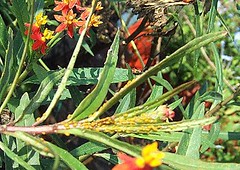
The other insects that enjoy milkweed are milkweed seed bugs. These orange and black bugs feed on the milkweed seeds. In the picture below, there is an adult in the upper right corner and lots of young nymphs on the milkweed seed pod. Usually there are only a few to be found and they can be picked off by hand. Occasionally, however, the population gets out of hand. You can try keeping the seed pods removed; otherwise spraying with insecticidal soap may be your only recourse.
Tuesday, July 03, 2007
Herbal Flowers #3
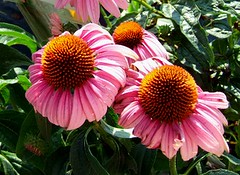
Echinacea spp. or purple coneflower produces beautiful flowers for any garden including the herb garden and butterfly garden. Native to the Midwest prairies, its medicinal roots were first used by native American Indians and it is considered today a major herbal immuno-stimulant. Butterflies love it as a nectar plant.
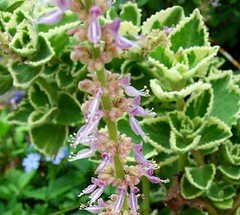
Besides the many species of true oreganos (Oreganums) there are a number of other oregano tasting plants which use the common name oregano and are often substituted for the true oreganos in culinary applications. One such herb is Cuban oregano, Plectranthus amboinicus. Originally classified as a coleus and named Coleus amboinicus, it comes in a plain green form as well as several differently variegated forms, one of which is pictured above. Plants in the Coleus and Plectranthus genera are part of the Lamiaceae (mint) family and the flowers are typical of that family. The real and year-round beauty of this plant, though, comes from its variegated leaves.
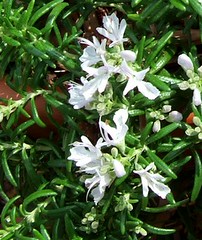
Many customers at my herb farm express surprise when they see mature rosemary plants covered in flowers. Yes, rosemary does flower and the flowers come in many colors: pink, white, light lavender, light blue and deep blue. These flower colors are reflected in many of the varietal names: Majorca Pink, Alba, Tuscan Blue, etc.
Pictured is a new variety of rosemary called Haifa which I loved right away. It's a very low-growing prostrate variety with dark glossy leaves and a kind of twisty growth habit. I loved this variety even more when it flowered. It had the largest flowers I have seen on any of my rosemarys and the stems were just solid with them. Fantastic.
Subscribe to:
Posts (Atom)


