Belonging to an herb society is a good way to learn about herbs. Herb enthusiasts are great people and love to share their knowledge. Meetings are fun and often involve eating wonderful food!! Many have newsletters full of good information including tips on growing herbs in our challenging climate. Check out one of these herb groups near you (listed north to south with two regional organizations at the end):
Jacksonville Herb Society
Contact: Scott Stover, President
(904) 945-8965
Email: stovershop@comcast.net
Meets 10:30 am the third Saturday of every month at
Glynlea Grace United Methodist Church
6429 Atlantic Boulevard in Jacksonville.
Updated 1/10/08
The Herbal Link
Contact: Loretta Inman
(904) 382-8080
Email: lori_inman@bellsouth.net
Tallahassee Herb Society
Contact: Kay Fausel, President
or Alice Cappa, Newsletter Editor
(850) 997-5505 (Alice Cappa)
Email: acappa@att.net
Meets 7:00 pm the second Wednesday of every month
at various locations.
North Central Florida Herb Society
Contact: Barbara Bennett
(352) 372-4981
Meets 7:00 pm the third Tuesday of every month
except during the summer
at the downtown library on East University in Gainesville.
Deland Herb Society
Contact: Karen Hall, President
(386) 736-1839
Meets the first Thursday of every month September - May
at the Garden Club of Deland
Seaside Herb Society
Contact: Kathy Kosak, President
12 San Jose Circle
Ormond Beach, FL 32176
(386) 441-3382
Email: nrkosak1@bellsouth.net
Meets 9:30 am the third Saturday of every month
at Riverbend Community Church, Beach and Granada Streets
in Ormond Beach.
For more information: http://dir.gardennet.com
Updated 1/10/08
Thyme on Our Hands (Spruce Creek)
Contact: Nelda Ewald
2882 Grumman Court
Daytona Beach, FL 32128
(386) 760-4235
Email: flyer12941@aol.com
Meets the third Friday of every month
at various members' homes.
Herb Society of Central Florida
Contact: Emily Ruff, President
PO Box 11183
Orlando, FL 32803
(407) 595-3731
Email: orlandoherbs@gmail.com
Meets 7:00 pm the second* Monday of every month
at Leu Gardens in Orlando.
*Note: meetings were changed from first to second Monday starting Sept 2008
Updated 9/24/08
Hernando Herb Society
Contact: Mary Repper, President
(352) 799-5717
Email: maryrepper@aol.com
Meets the fourth Monday of every month September - May
at the Hernando Extension Office in Brooksville.
Updated 1/11/08
Florida Herb Society
Contact: membership@floridaherbsociety.org
Emily Wenzel emily@floridaherbsociety.org (727) 365-8574 or
Yetta Jaworski yetta@floridaherbsociety.org (727) 517-8970
Meets 6:30 pm (herb swap) / 7:00 pm (meeting)
the third Tuesday of every month September - June
at the Clearwater Garden Club 405 Seminole St in Clearwater.
For more information check out their very informative website: www.floridaherbsociety.org
Updated 6/10/10
Manatee Herb Society
Contact: Sue Moury, President
(941) 795-8828
Email: BrendaJohson@msn.com
Meets the third Wednesday of every month except July and August
alternating evenings and afternoons at the public library
1301 Barcarrota Boulevard in Bradenton.
Updated 9/23/04
The Vero Beach Herbal Society
Contact: Julie McCusker, President
PO Box 262
Winter Beach, FL 32971
(772) 778-9328 Greens & Things
Meets 7:30 pm the second Tuesday of every month
at the Vero Beach Community Center.
Heathcote Herb Society
Contact: Linda LeMieux, President
(772) 464-4672 Heathcote Botanical Gardens
Email through Heathcote Botanical Gardens: hbg@ircc.net
Meets at Heathcote Botanical Gardens in Fort Pierce
Updated 10/26/04
Herb Society of Palm Beach County
Contact: Linda Spillane, President
or Edith Peekin (561) 640-7943
Write: c/o Mounts Botanical Garden
531 N. Military Trail
West Palm Beach, FL 33415
Meets 10:00 am the second Tuesday of every month except July and August
at Mounts Botanical Garden in West Palm Beach
For more information: http://dir.gardennet.com/
Evening Herb Society of the Palm Beaches
PO Box 17318
West Palm Beach, FL 33416
Voicemail: (561) 835-6724
Email: talk2EHS@gopbi.com
Meets 7:30 pm the last Tuesday of every month
at Mounts Botanical Garden in West Palm Beach
For more information: http://communitylink.gopbi.com/
Updated 1/10/08
Broward County Herb and Spice Society
Contact: Sharon Sootin
(954) 921-5111
Email: mudanacher@aol.com
Meets 7:30 pm the fourth Monday of every month
at the Broward County Extension Education Division,
3245 College Ave in Davie
Updated 1/10/08
Redland Evening Herb Society
Contact: Leila Barnes
(305) 245-3367
Email through Fruit and Spice Park: fsp@miamidade.gov
Meets 7:30 pm the first Wednesday of every month
at Fruit and Spice Park in Homestead
A great informative website: http://www.rehsonline.com/
Updated 2/28/06
Herb Society of America Southeast District (Includes Florida)
Contact: Helen Phillips
13580 Highway 27
Hamilton, GA 31811
(706) 628-0075
Email: hkphillips@earthlink.net
Members-at-large meet annually.
For more information: http://www.herbsociety.org/
International Herb Association Southeast Regional Chapter (Includes Florida)
Contact: Marge Powell
PO Box 5667
Jacksonville, FL 32247
(904) 399-3241
Email: margepowel@aol.com
For more information: http://www.iherb.org/
Updated 5/18/04
Do you know of another herb society in Florida? Is there an error, an email address no longer valid or an update needed in any of the above listings? Please let us know in the comments or at rhgherbfarm@yahoo.com .
Thursday, June 10, 2010


Monday, January 04, 2010
Maggie

To all of my customers who have been asking after Maggie, the border collie greeter at my old location, I'm sad to report that she died between Christmas and New Years. Maggie had a good life, was much loved and lived to be over 100 in dog years.
Her favorite things:
1. Frisbees
2. Swimming
3. Swimming after Frisbees thrown into the lake
4. Playing hide and seek
5. Frisbees
6. Trying to catch the water from the garden hose
7. Really loud squeeky toys
8. Waiting for the dog to bark at the end of the Mclaughlin Group. (That dog was saying something to her!)
9. Did I mention Frisbees?
R.I.P. Maggie my BDFF.
Tuesday, November 03, 2009
Herbal Flowers #7

Pictured above are nasturtiums, Tropaeolum majus, one of my favorite herbs. The flowers are not only beautiful in the garden, but are one of the best edible flowers around.
A member of the Cruciferae (mustard) family, nasturtium has leaves and flowers with a great cress-like peppery taste from benzyl isothiocyanate, a form of mustard oil. High in vitamin C, the leaves as well as the flowers make a great addition to a salad of mixed greens. I have also made a delicious pesto using half nasturtium leaves and half parsley instead of the usual basil.
Now is the time of year to start growing nasturtiums here in Florida as they deteriorate in the intense heat of our summers. They also dislike extreme cold, so take care to protect them or bring them in when the temperature dips into the 30s. They're easy to grow, preferring full sun and very little fertilizer in order to flower. (Too much fertilizer will give you lots of leaves with little flowering.) Nasturtiums come in mounding and vining forms, several flower colors and a variety with variegated leaves.
Thursday, March 19, 2009
Thursday, December 25, 2008
Friday, October 31, 2008
Five Things I Learned About Dogs Last Saturday Night

Maggie with a butterfly on her head
Five things I learned about dogs last Saturday night:
1. It’s surprisingly easy to forget that grapes are toxic to dogs until 2 seconds after yours has eaten the last bite of the leftover chicken salad Veronique you shouldn’t have given her.
2. According to various sites on the internet and the doctor answering the phone at the emergency veterinary clinic, hydrogen peroxide is the accepted method of inducing vomiting in dogs.
3. It’s easy to get the first teaspoon of hydrogen peroxide down a dog’s throat. The next few teaspoons, not so much.
4. About 20 minutes after swallowing a ¼ cup of hydrogen peroxide, a dog will expel all its previously eaten dinner along with an amazingly sticky mass of foaming goo.
5. Dogs are very quick to forgive.
Tuesday, August 12, 2008
In the Butterfy Garden: Caterpillar Predators
Customers often tell me that caterpillars they've been watching have suddenly disappeared and they wonder what could have happened to them. Sometimes they've just grown up and have gone off to pupate. But often they have become a victim of predators. Birds, of course, love a nice tasty caterpillar, but many smaller critters are predators as well. I recently captured two such predators with my camera.
This is a paper wasp devouring a monarch caterpillar. . . .

And this is what's left of a monarch caterpillar after a wasp is through with it:

Lizards (or anoles as most of our lizards are appropriately called) eat butterfly eggs and caterpillars. Here is a lizard with an adult butterfly. It was at the end of it's life and was struggling on the sidewalk. I could see the lizard eyeing it and then grab it. It was a pretty heavy load for the lizard so I had time to run get my camera and snap this picture just before the poor butterfly was carried into the brush:

This is a paper wasp devouring a monarch caterpillar. . . .
And this is what's left of a monarch caterpillar after a wasp is through with it:
Lizards (or anoles as most of our lizards are appropriately called) eat butterfly eggs and caterpillars. Here is a lizard with an adult butterfly. It was at the end of it's life and was struggling on the sidewalk. I could see the lizard eyeing it and then grab it. It was a pretty heavy load for the lizard so I had time to run get my camera and snap this picture just before the poor butterfly was carried into the brush:
Friday, July 04, 2008

Friday, June 13, 2008

Saturday, February 16, 2008
The Old Florida Flame Vines

The flame vines seem to be particularly beautiful this year including the one that has enveloped the tree above. They always remind me of the old Florida my family moved to in 1955. They were a lot more prevalent then including on the old linen postcards of that era:

Thursday, February 07, 2008
Early February Butterfly Count
Red admiral on bright pink pentas
Throughout the winter I have been seeing lots of monarchs and zebra longwings, the occasional sulphur and not much else. But suddenly yesterday I saw so many butterflies appearing for the first time this year. A quick species count from the past 3 days:

blue cassius
red admiral
yellow sulphur
monarch
zebra longwing
gulf fritillary
gold rim swallowtail
Sunday, February 03, 2008
"I think using fresh herbs makes you more adventuresome in the kitchen."
Rabbit Hill Gardens and I are mentioned and quoted by Tom MacCubbin in two articles on herbs in today's Orlando Sentinel. Thanks Tom. One mistake in one article, however: it is culantro not cilantro that does well in the summer. Cilantro is a cool-weather annual like dill that bolts quickly and wilts in the heat. Culantro is a warm weather perennial that thrives in the heat and has a very similar taste.
Saturday, January 26, 2008
In the Butterfly Garden: Another Milkweed
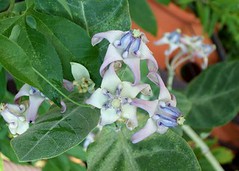
Several years ago I started seeing growers selling giant milkweed (Calotropis gigantea) at butterfly gardening festivals. These were large plants in 3 gallon pots that sold in the neighborhood of $25. Though I had not seen any with monarch caterpillars, I was assured the giant milkweek was a good host plant. After seeing them several times, I finally broke down, purchased one and started taking cuttings. My hope was to be able to offer smaller plants at a lower price. They are not the easiest thing to propagate, but I have several going and sell them in a 1 gallon pot for $9.99.
Giant milkweed gets to be a large plant several feet high and would be great in ground here in central Florida except that our winter weather is a bit too cold. Calotropis is recommended for US zones 10B-11. We are 9B. My recommendation is to grow it in a large container and bring indoors when the temperature dips into the 30s.
The leaves of giant milkweed are large and a silvery green. The flowers come in lavender or white, though I only have the lavender. I've had plenty of flowers, but have yet to get any seed pods.
So the big question for butterfly gardeners is are they good host plants? Answer:
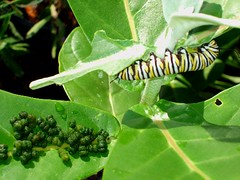
I've had lots of healthy monarch caterpillars on my giant milkweeds. And, as you can see, the large leaves give them more to eat than regular milkweed and also make a nice platform for collecting caterpillar poop.
Tuesday, November 06, 2007
In the Butterfly Garden: Two Plants with Fall Color
Among the best plants for fall color are two that are also great plants for the butterfly garden.
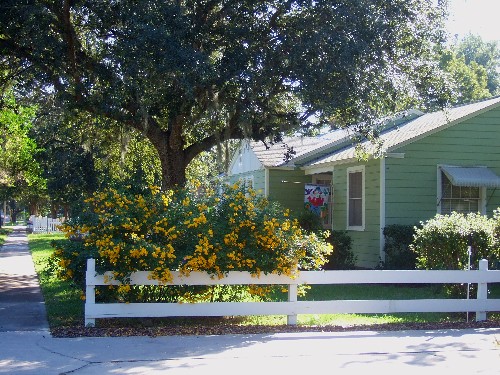
The first is Senna bicapsularis (syn. Cassia bicapsularis) with the common names of Christmas senna, winter cassia and fall cassia, all indicating that this is the time of year when they are at their peak of blooming. Fall cassia can be kept pruned into a tall shrub or can be let loose to form a small tree (10-12 feet). Right down the street from me on 11th Avenue in Mount Dora are a couple of fall cassias that have been planted to beautiful effect behind a white fence:


The first is Senna bicapsularis (syn. Cassia bicapsularis) with the common names of Christmas senna, winter cassia and fall cassia, all indicating that this is the time of year when they are at their peak of blooming. Fall cassia can be kept pruned into a tall shrub or can be let loose to form a small tree (10-12 feet). Right down the street from me on 11th Avenue in Mount Dora are a couple of fall cassias that have been planted to beautiful effect behind a white fence:
Fall cassia is a host plant for a number of sulphur butterfly caterpillars. These butterflies usually zoom through the yard without stopping, but will stop to lay eggs and perhaps stick around for a bit of nectar from one of your nectar plants. Pictured is a female sulphur laying an egg:

The second plant with great fall color is our native firebush (Hamelia patens) with its orange flowers and black berries. Firebush gets to be a tall shrub and can be grown in either full sun or partial shade. It is a favorite nectar plant of the two passionvine butterflies in our area: the gulf fritillary and the zebra longwing.

Thursday, September 06, 2007
Mislabeled
I was starting some nasturtium seeds today and saw on one of the packages something that reminds me how often garden things are mislabeled for Florida.
Many seed packages have a little map on the back and a chart that shows which months the seeds should be started in each area. For nasturtiums, which do best in cool weather, the package from American Seeds had it right: start seeds here Sept-Feb. This way they will be growing in the cool fall, winter and early spring and will only have to be protected on those few nights when temperatures approach freezing. But the Northrup-King seed package had it exactly backwards: start seeds here Feb-Sept. Obviously they were following the first frost dates for the northern zones and continued it for the most southern. But that would have us growing nasturtiums in late spring and summer when they will struggle in the heat.
I'm constantly running across things I think are mislabeled, especially mislabeled for Florida and I will try to post more as I run across them.
Many seed packages have a little map on the back and a chart that shows which months the seeds should be started in each area. For nasturtiums, which do best in cool weather, the package from American Seeds had it right: start seeds here Sept-Feb. This way they will be growing in the cool fall, winter and early spring and will only have to be protected on those few nights when temperatures approach freezing. But the Northrup-King seed package had it exactly backwards: start seeds here Feb-Sept. Obviously they were following the first frost dates for the northern zones and continued it for the most southern. But that would have us growing nasturtiums in late spring and summer when they will struggle in the heat.
I'm constantly running across things I think are mislabeled, especially mislabeled for Florida and I will try to post more as I run across them.
Saturday, August 25, 2007
Herbal Flowers #6
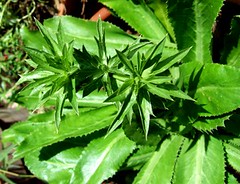
Earlier in this Herb Flowers series, I showed pictures of cilantro flowers. The spiky green flowers above are from a cilantro-flavored herb called culantro (Eryngium foetidum). Culantro is native to Mexico and Central and South America where it is widely used. It is great for Florida where cilantro is quick to bolt and is extremely difficult to grow in the summer garden. While cilantro is a cool weather annual, culantro is a warm weather perennial. It will grow here all year round, but needs to be protected if the temperature dips into the 30's. Grow in partial shade; it will take the heat of our summers but not in full sun.
Culantro is a low growing plant with flower spikes that have a conical flower head surrounded by spiky leaves that can be quite prickly to the touch. The lower basal leaves have a saw-toothed edge, but are soft and edible. They are the part used in culinary applications and can be used wherever cilantro is called for. Remove the flower spikes to encourage more basal leaf growth.
Thursday, July 12, 2007
Thank you Lady Bird Johnson
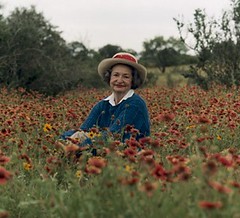
Picture in public domain available from Johnson Library.
Thank you Lady Bird Johnson for making this country a more beautiful place. In 1998, before I opened Rabbit Hill Gardens, I went to an Herb Growing & Marketing Network conference in San Antonio which offered a bus tour that included the famed Frederickberg Herb Farm and the Lady Bird Johnson Wildflower Center. The tour through her beloved Texas Hill Country was definitely the best part of a great conference. Rest in peace Lady Bird.
Sunday, July 08, 2007
Herbal Flowers #5
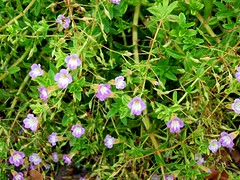
These cute little purple and white flowers belong to rice paddy herb (Limnophila aromatica) one of my favorite smelling herbs. Easily recognized by those familiar with Vietnamese cooking, it is unfamiliar to most of my customers. The scent is quite powerful, nearly identical to cumin, and I'm hoping to find a good recipe utilizing it. Anyone?
As the name indicates, it is native to southern Asia and grows in very wet areas. It is rated for zone 10. I was struck with the similarity between this herb and the water hyssops in our butterfly garden: similar flowers, long succulent stems, similar succulent leaves and watery habitat. Sure enough, they are in the same plant family, Plantaginaceae.
Saturday, July 07, 2007
Looking for photos of roadside gardens
Sissy Willis calls it "when plants garden". You know, roadside wildflowers that pop up without being planted. Fred First is looking for pictures for his online gallery Unplanted Gardens: America's Roadside Bloomery. Go there to see a beautiful example and how to submit your own photos. And look around Fred's site for more gorgeous photos from the Blue Ridge Mountains.
Friday, July 06, 2007
Herbal Flowers #4
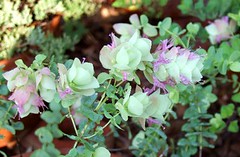
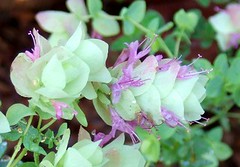
This is Oreganum 'Kent Beauty', an ornamental oregano with beautiful flowers unlike any other oreganos. Rated for zones 5-8 (we're in 9B here in central Florida) and liking a dry, very well-drained soil, it's obviously not going to be the easiest plant to grow here, but well worth the trouble.
Subscribe to:
Posts (Atom)


